The immediate problem buyers face
Buyers are pushed to choose quickly and regret slowly. Suppliers promise “biodegradable” and “soil-friendly” yet deliver films that fragment but don’t mineralise, clog irrigation, or leave residues. Start by reading labels; also look beyond marketing to the technical dossier for any agriculture plastic film you consider.

How problems reveal themselves in the field
Crop loss shows up where films fail: poor tensile strength tears during laying, uneven degradation smothers seedlings, and incompatible additives alter soil biology. A practical way to gauge risk is to require objective lab evidence and a short on-farm trial rather than a brochure promise.
Verify standards and test certificates — be specific
Ask for test reports tied to recognised standards. Good ones include EN 17033 for biodegradable mulch films and ASTM D6400 for compostable plastics; these discuss biodegradation and ecotoxicity criteria. Request full lab reports, not just pass/fail stickers. Check the test conditions (soil type, temperature, duration). Confirm whether third parties performed the tests and whether the results match the crop cycle you run.
Material chemistry and additive transparency
Demand a full bill of materials and supplier declarations for any additives—slip agents, UV stabilisers, fillers. Some additives slow biodegradation or introduce heavy metals. Insist on material safety data sheets and certificates of analysis for polymer feedstocks. If a manufacturer won’t disclose formulation details, treat that as a red flag.
Mechanical specs and application fit
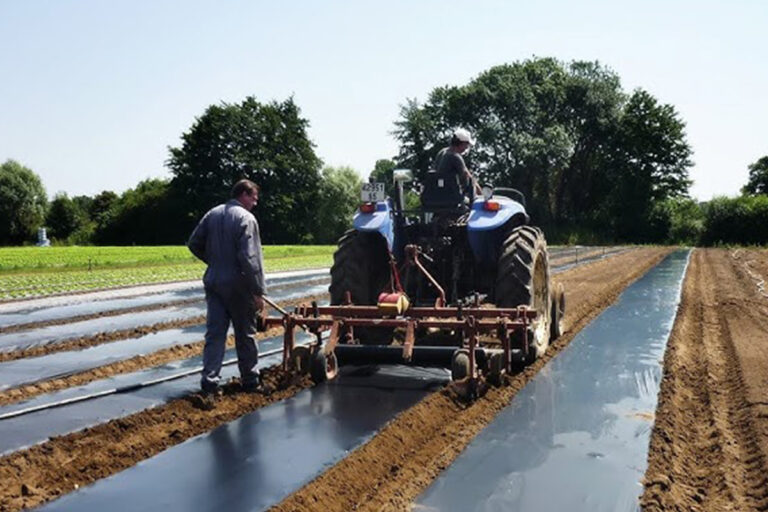
Match film thickness, tensile strength, elongation, and tear resistance to your machinery and crop. Verify laying equipment compatibility and whether films withstand knotting or winding stresses from your planter. Confirm that the manufacturer provides handling guidelines and tolerances for temperature and humidity during storage.
Field compatibility: a real-world anchor
Practical experience matters. For example, growers in California’s Central Valley have combined mulches with specialised irrigation and observed different degradation timing depending on soil warmth and water contact; published trials from regional agricultural extension services track those outcomes. That kind of context is why you should test how a film behaves with your irrigation method, including a drip tape watering system, so you don’t discover incompatibility in the middle of a season.
Biodegradation metrics buyers must request
Insist on clear endpoints: percentage mineralisation over a defined period under realistic soil conditions, breakdown products identified, and ecotoxicity results for soil organisms. Ask whether the manufacturer conducted field degradation trials in climates similar to yours and whether residues were quantified post-harvest.
Traceability, quality control and factory audits
Verify batch traceability, incoming raw-material checks, and production-line QC records. Request third-party factory audit summaries or offer to commission one. Confirm whether the plant runs dedicated lines for biodegradable polymers or handles conventional plastics on shared equipment; cross-contamination risks matter.
Common procurement mistakes to avoid
Don’t buy on price alone. Don’t accept superficial certificates without the underlying data. Avoid choosing a film solely because it’s thin or bright white; those are cosmetic. Don’t skip a short, local pilot plot: small-scale failure is cheaper than full-season loss.
Viable alternatives and short comparisons
If a biodegradable film can’t be verified to meet your needs, consider certified compostable mulches removed mechanically after harvest, paper mulches for short-season crops, or improved weed management plus conventional film with robust recycling. Each option has trade-offs: labour, cost, and end-of-life handling. Weigh those against verified performance data.
How to negotiate supply terms and warranties
Insist on performance clauses tied to measurable outcomes: degradation window, absence of residues above a specified threshold, or replacement obligations for faulty batches. Ask for storage and handling warranties; film improperly stored will degrade or stick before use. Include a clause requiring delivery of full lab reports for each batch shipped.
The final judgement — what good verification delivers
Practical checks, transparent data, and a short trial remove guesswork. Your procurement decision should rest on documented standards compliance, third-party testing, traceable production, and evidence of field compatibility with your irrigation and crop cycle. Those steps reduce risk and let you choose a supplier whose product actually performs in your fields—considerations an experienced buyer would expect from HGDN.
MOST COMMENTED
Farming
What Buyers Must Verify When Selecting Biodegradable Agricultural Film Manufacturers
What Buyers Must Verify When Selecting Biodegradable Agricultural Film Manufacturers
Games
Cards, Curses, and Court Intrigue: A Look at Sultan’s Game
Cards, Curses, and Court Intrigue: A Look at Sultan’s Game
Business
Commodity CFD Essentials for Metal Traders: Contracts, Costs, and Real-Time Monitoring
Commodity CFD Essentials for Metal Traders: Contracts, Costs, and Real-Time Monitoring
Tech
A Quiet Calculus: A Practical Procurement Guide for Ultrasonic Sensors
A Quiet Calculus: A Practical Procurement Guide for Ultrasonic Sensors
Outdoor
Quiet Shifts: An Evolutionary Look at Gear for Car Camping, Hiking, and Glamping
Quiet Shifts: An Evolutionary Look at Gear for Car Camping, Hiking, and Glamping
Tech
Utility-Grade vs Commercial-Grade Hybrid Inverter: Practical Trade-offs in Anti-Islanding Disconnection Under IEEE 1547
Utility-Grade vs Commercial-Grade Hybrid Inverter: Practical Trade-offs in Anti-Islanding Disconnection Under IEEE 1547
Business
Gensets vs. Alternatives: A Practical Comparative Lens on Backup Power Choices
Gensets vs. Alternatives: A Practical Comparative Lens on Backup Power Choices